The war in Bosnia


The war in Bosnia - Help Bosnia now
        The war in Bosnia was a bloodbath in the middle of modern Europe. In 1991 Bosnia had 4,364 600 inhabitants. 250 000 men were killed during the war, 35 000 women were raped. At the peak of the war almost 2,000 000 people were displaced as refuges.But before the war in Bosnia, we are going to mention how the Yugoslavia falled apart. The war in Bosnia came as a result of the breakup of the Socialist Federal Republic of Yugoslavia. Crisis emerged in Yugoslavia with the weakening of the Communist system. Meanwhile nationalism was in uprising. In March 1989, the crisis in deepened after government of Serbia imposed dominance over the autonomous provinces of Kosovo and Vojvodina.

         On 25 June 1991, both Slovenia and Croatia declared independence which led to a short armed conflict in Slovenia called the Ten-Day War, and an all-out war in Croatia in the Croatian War of Independence in areas with substantial Serb populations. On 15 October 1991, the parliament of the Socialist Republic of Bosnia and Herzegovina in Sarajevo passed a "Memorandum on the Sovereignty of Bosnia-Herzegovina" by a simple majority. On 25 January 1992, an hour after the session of parliament was adjourned, the parliament called for a referendum on independence on 29 February and 1 March. Independence was declared on 5 March 1992 by the parliament. The Serb political leadership used the referendums as a pretext to set up roadblocks in protest.

        Then the bad thing happens. On 25 September 1991, the  UN imposed an arms embargo on all of the former-Yugoslavia. The embargo really only had impact on Bosnian army, because Serbs inherited the Yugoslav People Army's arsenal and the Croatian Army could smuggle weapons through its coast. Over 55% of the armories and barracks of the former Yugoslavia were located in Bosnia owing to its mountainous terrain, in anticipation of a guerrilla war, but many of those factories were under Serb control (such as the UNIS PRETIS factory in Vogošća), and others were inoperable due to a lack of electricity and raw materials. The Bosnian government lobbied to have the embargo lifted but that was opposed by the United Kingdom, France and Russia. US proposals to pursue this policy were known as lift and strike. The US congress passed two resolutions calling for the embargo to be lifted but both were vetoed by President Bill Clinton for fear of creating a rift between the US and the aforementioned countries. Nonetheless, the United States used both C-130 transports and back channels including Islamist groups to smuggle weapons to Bosnian-Muslim forces via Croatia.

The war in Bosnia - Welcome to Sarajevo
     
       The Yugoslav People's Army (JNA) officially left Bosnia and Herzegovina on 12 May 1992 shortly after independence was declared in April 1992. However, most of the command chain, weaponry, and higher-ranked military personnel, including general Ratko Mladić, remained in Bosnia and Herzegovina in the Army of Republika Srpska  (VRS) as the armed forces of the newly created Bosnian Serb republic. The Croats organized a defensive military formation of their own called the Croatian Defense Council (HVO) as the armed forces of Herzeg-Bosnia. The Bosniaks mostly organized into the Army of Republic of Bosnia and Herzegovina (ARBiH) as the armed forces of the Republic of Bosnia and Herzegovina. Initially, 25% of the ARBiH was composed of non-Bosniaks, especially in the 1st Corps in Sarajevo. Sefer Halilović, the Chief of Staff of the Bosnian Territorial Defense, claimed in June 1992 that his forces were 70% Muslim, 18% Croat and 12% Serb. The percentage of Serb and Croat soldiers in the Bosnian army was particularly high in cities such as Sarajevo, Mostar and Tuzla.The deputy commander of our army's headquarters, was general Jovan Divjak, the highest-ranking ethnic Serb in the Bosnian Army. General Stjepan Šiber, an ethnic Croat was the second deputy commander. President Izetbegović also appointed colonel Blaž Kraljević, commander of the Croatian Defence Forces in Herzegovina, to be a member of Bosnian Army's Headquarters. Different nationalities in the same army during the war may seem strange to some, but all of them were fighting for something they love and cherish in their heart , and they couldn't let anybody take that away from them no matter what was their nationality.

The war in Bosnia -  Welcome to hell

        The first victim of the Serbian aggression were the Croats, who similarly to the present destiny of Kosovo Albanians, were removed from 30% of the Croatian territory. That territory was not only occupied by the Yugoslav army and the local Serbs and ethnically cleansed of Croats, but in addition Serbs from other parts of Croatia or Bosnia were persuaded to resettle into abandoned Croatian homes in the cleansed territory for the Greater Serbia. Such behavior escalated national animosities as the aggression spread on and on. In Bosnia and Herzegovina 70% of the territory was ethnically cleansed from Croats and Bosniaks and only with the Dayton Agreement and NATO intervention the war in Bosnia was stopped and the Serbs forced to restrict their control to Serbian Republic (Republika Srpska) encompassing 49% of Bosnian territory.

        The Dayton Peace Accords, signed on December 14, 1995, by Presidents Milosevic, Izetbegovic, and Tudjman, affirmed Sarajevo as the capital of Bosnia but carved Bosnia into two autonomous and ethnically based entities, separated by a demilitarized zone. The Serbs, in control of the Republika Srpska, were rewarded for their unbridled aggression and genocide with 49% of the territory of Bosnia. We were granted the remaining 51% of the country, called the Federation of Bosnia and Herzegovina, an uneasy alliance of Bosnian Muslims and Croats. Each entity has its own government, military, and police. A central government handles our banking and foreign policy.

        Today Sarajevo is alive & buzzing, and we are notably friendly and hospitable, well most of us are , but that's the case in the whole world. A lot of past still haunts those who live here but we, Bosnians, are proof that you can get over the absolute worst that can happen. It will never be cleared or explained why the absolute worst happens, and why innocent people have to suffer the lasting consequences of something they didn’t create.

War, who needs this ?

Vijećnica - City Hall / National Library

Vijećnica Today
        Last night the National Library , "Vijećnica", one of the simbols of our city which was burned down in war, was shining with bright different color lights, proud of it's new looks. Front side entrance was lighted with red giving a impression of  curtain in theatere. It's nice to see building repaired, that was one of the reasons form me to write this post today and tell you something about Vijećnica.
Vijećnica - City Hall

        The National Library or City Hall, is the largest and most representative building of the Austro-Hungarian period in Sarajevo. It was built with purpose, to be the headquarters of the city and authority. Design was composed in 1891 by the architect Karl Parik, but criticisms by the minister, Baron Benjamin Kallay, caused him to stop working on the project. Next in line was Alexander Wittek, who worked on the project in 1892 and 1893, fell ill and died in 1894 in Graz, and the work was completed by Ćiril Iveković. The edifice was built in a stylistic blend of historical electisim, predominantatly in the pseudo-Moorish expression, for which the stylistic sources were found in the Islamic art of Spain and North Africa. Building works began in 1892 and were completed in 1894. It was formally opened 20 April 1896, and handed over to the City Authority, which occupied the property until 1949, when it was handed over to the National and University Library of Bosnia and Herzegovina.

Postcard of City Hall Vijećnica


Vijećnica in a stormy night
        During the war, on the night of 25 to 26 August 1992 the City Hal was hit by Serbian shelling during the Siege of Sarajevo, which caused the complete destruction of the library; among the losses were about 700 manuscripts and incunabula and a unique collection of Bosnian serial publications, some from the middle of the 19th century Bosnian cultural revival. Before the attack, the library held 1.5 million volumes and over 155,000 rare books and manuscripts. Some citizens and librarians tried to save some books while they were under sniper fire, at least one person died.

         During  quantites of heavy artillery and incendiary bombs, burned out and largely destroyed, causing incalcuable dmage to the physical structure of the building and to the library holdings.The majority of the books could not be saved from the flames.

City Hall in flames
         The structural repair of the building was planned to be carried out in four stages: 1996-1997 (financed by a donation from Turkey), and 2000-2004 (financed by a donation from the Turkish Commission). The third stagewas predicted to end sometimes this month, with an estimated cost of 4.6 million KM (about €2.37 million) and will return the city hall to its former grace. The fourth stage is slated to begin following the completion of the third stage and will last about 20 months, with a predicted finish at the end of 2013 and cost of 14 million KM (about €7.23 million) which are secured through the IPA. In this stage the whole interior will be built and reconstructed (paintings, sculptures, books), meaning the building will be brought back to function. Everything that was possible to restore has been done so, while those things that were not possible to save have been made anew through special molds. The whole reconstruction and restore process is predicted to cost about 25 million KM (about €13 million). The opening of the reconstructed building is scheduled in the first half of 2014.

Vijećnica before the war
        After it is repaired, the building, now a national monument, will be used for variety of events. The national and university library of Bosnia and Herzegovina will be placed in it, as well will be the City Council session hall. Its space will be also used for various protocol events for all levels of government, concerts and exhibitions.


Where is Sarajevo ?

Where is Sarajevo ? 
       Sarajevo Bosnia. Where is Sarajevo today? Is Sarajevo in Bosnia ? Where is Sarajevo after the war in Bosnia?  I'm sure a lot of people ask themselves the same questions. A lot of you are surfing the Internet right now searching the term where is Sarajevo? Well we are still here, in Bosnia, I have to disappoint Mr. Kissinger's but despite his words and wishes about mythical Bosnia, a land that has never existed, land that has none of it's history and language, and a land that should have been destroyed and divided in a war that tried to destroy everything. And it happened not in Africa, Asia or some remote country, it happened in the middle of Europe,  Bosnian genocide in the back garden of NATO and other so called peace protectors.

        But we survived the Bosnian genocide. We are still here today, standing as a proud proof of victory and life after all the horror that Bosnia and Sarajevo survived. Do you know that the siege of Sarajevo is the longest lasting siege in history of one city. Three years longer than Stalingrad's, and one year longer than Leningrad. And we survived. You can all do all the research about how it was done but all that you'll learn is that in reality it couldn't been done. Sarajevo was expected to fall in a day. We lasted 4 years ! Nobody should try to understand how impossible was done, because you can't explain the will of Sarajevo, people feelings and so called "inat"(spite) when you try to take something of their own. And we fought a battle for our city and our country , and we are still proud today to be in Sarajevo and Bosnia and nobody could take that away from us.

Sarajevo Today
       So I call you all to come to our city, you won't be disappointed at all. Don't believe everything you read or hear, except on this blog of course, and do visit us soon and in large numbers. You have a lot of stuff to see and learn in Sarajevo, and you'll of course find a lot of information about Sarajevo attractions, and places to go and see in Sarajevo right here on this blog. If you have any questions, or if there is anything you would like to know and find out, fell free to mail me and I'll try to help you in any way I can, from Sarajevo hotels, hostels, cheap tickets, attractions and all the things you ever wanted to know about Sarajevo but couldn't ask anybody I'll answer . We'll have a lot of fun here. This is just the beginning.

Sarajevo BiH


Miss Sarajevo U2 lyrics

 Miss Sarajevo U2 lyrics
 Songwriters: BRIAN ENO, BONO, ADAM CLAYTON, EDGE, LARRY MULLEN


Is there a time for keeping a distance
A time to turn your eyes away
Is there a time for keeping your head down
For getting on with your day

Is there a time for kohl and lipstick
A time for cutting hair
Is there a time for high street shopping
To find the right dress to wear

Here she comes
Heads turn around
Here she comes
To take her crown

Is there a time to walk for cover
A time for kiss and tell
Is there a time for different colors
Different names you find it hard to spell

Is there a time for first communion
A time for east 17
Is there a time to turn the mecca
Is there a time to be a beauty queen

Here she comes
Beauty plays the crown
Here she comes
Surreal in her crown

[Pavarotti]

Dici che il fiume
Trova la via al mare
E come il fiume
Giungerai a me
Oltre i confini
E le terre assetate
Dici che come fiume
Come fiume
L'amore giunger
L'amore
E non so pi pregare
E nell'amore non so pi sperare
E quell'amore non so pi aspettare

[English translation:]

You say that the river
Finds the way to the sea
And as the river
You'll come to me
Beyond the borders
And the thirsty lands
You say that as river
As river
Love will come
Love
And I cannot pray anymore
And I cannot hope in love anymore
And I cannot wait for love anymore

[Bono]
Is there a time for tying ribbons
A time for Christmas trees
Is there a time for laying tables
When the night is set to freeze

Miss Sarajevo U2


        So we'll continue to talk about U2 Miss Sarajevo and story behind it. As already told Bono was called by journalist Bill Carter to help spread the word about war and suffering in Sarajevo and to film a documentary based on Sarajevo resistance. Bono provided the funds for the movie and produced it. The film "Miss Sarajevo" is a documentary about a beauty pageant held in the middle of the war-torn Sarajevo. the winner was Inela Nogić.

Beauty pageant held in Sarajevo
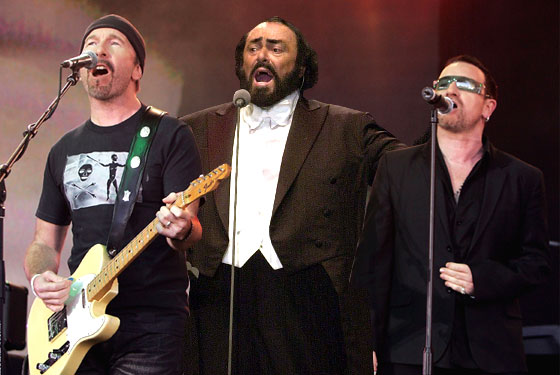
         The song protests the war in Bosnia and criticising the international community for it's inability to stop the war or do something to help the people affected by it. It's the only single from the 1995 album Original Soundtracks 1 by U2 where even Luciano Pavarotti makes a guest vocal appearance singing the opera and Luciano was very open to do the collaboration. "Miss Sarajevo" was first time performed on the 12th of September 1995 in Modena at the concert Pavarotti and friends. Next time it was played on U2's tour PopMart 1997 on Koševo stadium in Sarajevo. Since then the song has been played live many times on the band Vertigo tour, on the tour second leg in Amsterdam and was played each night for the remaining 86 shows in the tour. You'll find the lyrics of the song Miss Sarajevo by U2 in next post.

Edge, Pavarotii and Bono singing Miss Sarajevo

U2 concert in Sarajevo 1997 - Sarajevo under the Music

U2 Concert poster 
   
        So my friends today is a nice day to start posting some interesting stuff about Sarajevo for you to see and read. Today is the anniversary of U2's concert in Sarajevo that was held at Koševo Stadium in Bosnia and Herzegovina on 23 September 1997, 15 years ago guys. Wow, who would think that much time has pased from that day. Visiting the city on their PopMart Tour, U2 became the first major artist to hold a concert in Sarajevo since the end of the bloody Bosnian War. I decided to post some stuff about that conncert and what it meant to people of Sarajevo and the region.

         Despite U2's obligation to the tour and their inability to perform in Sarajevo during the war, they vowed to play the city someday. The band contributed to Bosnian relief efforts to enhancepublic awareness around the issue, and Bono wrote with Bill Carter a song called Miss Sarajevo ( we'll come back to that in a different post) as a response to the surreal acts of defiance that had taken place during the siege of Sarajevo. I guess we are well known for the defiance and spite we have, and one of them surrely was the beauty pageant that was held in the city durring the aggression with all the girls carrying a banner that said, "Don't let them kill us".

U2 concert poster and destroyed
bulding in the background
        U2 first became invalved with Sarajevo in 1993 on they ZOO TV tour. They were aproached by aid worker Bill Carter about bringing attention to the Siege of Sarajevo, and the band did nightly satellite transsmissions with Bosnians during their show. After the war ended in 1995 the band made arangemants to visit Sarajevo and with the help of UN, ambassadors and peace-keeping troups they scheduled and played the concert in 1997.

Trams with U2 posters
         As late as July 1997, U2 were pressured to accept an offer of approximately $4 million to perform in Basel, Switzerland on the date scheduled for the Sarajevo show. At the time, rumours about the region's instability persisted. For the stage to reach Sarajevo, the road crew had to drive the equipment and stage through war-torn Bosnia. Although the trip was without incident, they had to pass through towns such as Mostar, which had been "obliterated" during the war. The only trouble in transporting the stage came when a border control agent prevented them from crossing the border for hours. The trucks reached Sarajevo two days prior to the concert, arriving to the cheers and applause of the city's residents; their arrival was the first concrete evidence that the band were keeping their promise to play there. McGuinness explained, "This is a city that's been disappointed so many times there were a lot of people who weren't prepared to believe the gig was going to take place until they saw the stage going up."Until then, tickets had sold very slowly, but within 24 hours of the trucks' arrival, another 8,000 tickets were sold. Despite this, a day before the concert, 15,000 tickets remained unsold. Three-hundred local residents were employed to help assemble the stage and promote the show. 
U2 posters and a solider

        Several hundred members of the international "Stabilisation Force" (SFOR) were tasked with upholding the Dayton Agreement for the concert. The band were overwhelmed by the sights they saw when arriving. During the war, Koševo Stadium was used as a morgue, and graveyards were present on either sides. Although the venue had escaped the worst of the shelling, the nearby Olympic Hall Zetra had been badly damaged during the war. Despite its condition, U2 used the building for their dressing rooms and offices. Following the concert, it was used to provide lodging for 3,000 fans.The band's hotel, a nearby Holiday Inn, had been shelled during the siege, and part of the building had been destroyed as a result. The walls in Mullen's room were punctured with mortar shrapnel, and sections of the floor were also missing. Prior to the show, Sacirbey took Mullen on a tour of the city, showing him the Sarajevo Roses embedded in the streets.

       "We worked quite hard to make sure tickets were available in Croatia and even from Republika Srpska we had about 1,000 people come down today which is great. We tried our best to make it as multi-ethnic as Sarajevo was, and will be again."
—Bono

        On the day of the concert, trains ran into Sarajevo for the first time since the start of the war. Two lines were opened, one from Mostar to Sarajevo and the other from Maglaj to Sarajevo. Although the railways had been functional for the duration of the war, Muslim and Croat politicians could not decide who would operate them. As a result, the trains were only run on the date of the concert to bring fans to the city, and the day after to take them home again. An effort was made to include all of the country's ethnic groups at the concert. Approximately 500 fans crossed the ethnic boundary lines between Bosnia's Serb Republic and the Moslem-Croat Federation. People from several of the other Yugoslavian republics went to Sarajevo for the concert, with buses carrying fans from Zagreb, Croatia and Ljubljana, Slovenia. Security around the event was strict. SFOR soldiers searched for bombs with sniffer dogs, and the buildings around the stadium were lined with Irish troops and sharpshooters in case violence broke out.

Sarajevo under the music - Live


      The concert was held on 23 September 1997, and approximately 45,000 people attended. It was broadcast in Bosnia by local television networks, as well as globally by BBC. During the event, 10,000 soldiers stood on the left side of the stadium to ensure no conflicts broke out. At showtime, a decision was made to open the stadium gates to all, allowing approximately 10,000 more fans who could not afford the concert or who had not purchased tickets in time to attend. In addition to the local and foreign fans, 6,000 off-duty SFOR soldiers attended the event in uniform. Inela Nogic ( winner of the pageant that inspired miss Sarajevo) attended the concert and arrived in a limo with the band. Three opening acts played before U2, beginning with the Gazi Huzrev-Beg choir, an Islamic choir from a local high school. Their performance was followed by two local bands, Protest and Sikter, one of which was chosen personally by Sacirbey, and the other which was selected through a radio contest. 

Miss Sarajevo U2 live@Kosevo 1997.


         The band's set list was similar to that of most shows on the PopMart Tour, but with "Sunday Bloody Sunday" in place of The Edge's karaoke segment and the addition of "Miss Sarajevo" in the second encore. The night was a celebration of the end of the war, with Bono setting the tone by shouting out "Viva Sarajevo! Fuck the past, kiss the future!" at the beginning of "Even Better Than the Real Thing". Bono had struggled with his voice throughout the tour, and the morning of the concert he woke up "without a voice". There was no intent to cancel, and the show went ahead as planned.  

U2 Missing Sarajevo